At midnight, a bell rings.
Then another.
Then another.
Eleven belong to the town.
The twelfth belongs to Death.
A damaged violin begins to play.
A king hears it from his throne. A bishop hears it behind the altar. A soldier hears it after battle. A merchant hears it among his coins. Two lovers hear it beside a grave.
None of their titles matter by morning.
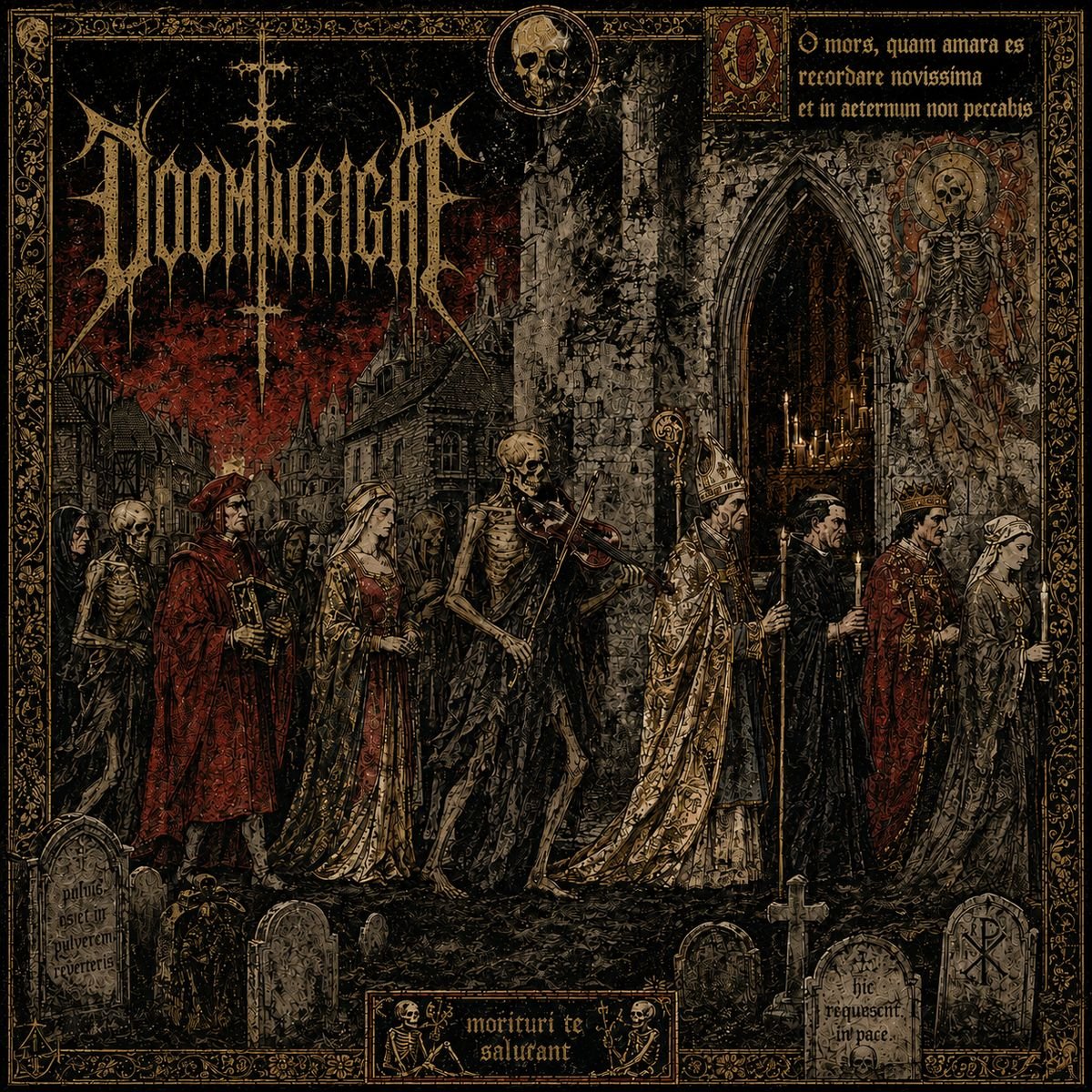
That is the world of THE LAST PROCESSION, but the idea behind it is much older than DOOMWRIGHT.
For centuries, European artists returned to a disturbing image now usually called the Dance of Death, or Danse Macabre: Death arriving for people from different classes, professions and stages of life and forcing them into the same final movement.
Kings.
Clergy.
Merchants.
Soldiers.
Ordinary people.
No rank could purchase exemption.
The Metropolitan Museum of Art preserves examples of the tradition going back to the fifteenth century, including a French Chorea ab eximio Macabre printed in Paris in 1490. Later Dance of Death cycles repeatedly placed figures of different professions and social positions in encounters with Death.
That social idea—not simply skeletons, graves or medieval imagery—is what interested me.
The album's central argument became:
Death does not conquer the living. It removes the names they used to rank themselves.
The Dance of Death Is Not Really About Dancing
The phrase Danse Macabre can make the tradition sound almost playful.
It is not.
The dance matters because a dance imposes a common rhythm.
The king can command his court.
The bishop can command ritual authority.
The soldier can command violence.
The merchant can control property.
But once Death sets the rhythm, those distinctions stop determining who moves first and who remains behind.
Historical Dance of Death imagery repeatedly placed Death beside people from different ranks and professions. Hans Holbein the Younger's famous sixteenth-century Dance of Death series includes figures such as the Pope, Bishop, Abbot and other social estates, while later versions after Holbein also depict figures such as the Miser. The point is not that one particular class is singled out, but that no social identity provides an exemption from the same encounter with Death.
That is much more interesting than the simple statement that everyone eventually dies.
Everybody already knows that.
The disturbing idea is:
the structures people spend their lives building cease to organize the procession.
A crown works only while other people agree that it means something.
Money works only among the living.
Military victory requires an opponent.
Office requires an institution.
Status requires comparison.
Death removes the system in which those identities function.
That became the real subject of THE LAST PROCESSION. The project was conceived explicitly not as a celebration of death but as a story about the collapse of human hierarchy before mortality.
Death Needed an Instrument
I did not want Death to arrive carrying a sword.
That would make him another warrior.
A scythe would have been obvious.
A throne would have turned him into another ruler.
Instead, Death carries a damaged violin.
He does not conquer people physically.
He begins the dance.
The violin therefore becomes Death's voice throughout the album.
Its main phrase is deliberately crooked: a four-note figure designed to resemble an old dance melody whose structure has been damaged and put back together incorrectly. It returns throughout the record but is never supposed to sound elegant or virtuosic.
The physical sound matters.
Wood.
String.
Bow hair.
Friction.
The violin should feel old enough to have played this procession before.
That distinction keeps the album away from another kind of Gothic fantasy in which Death appears majestic.
The Death in THE LAST PROCESSION does not need grandeur.
He only needs to keep time.
Why the Twelfth Bell Belongs to Death
The first track is “The Twelfth Bell.”
It establishes the album's entire ritual.
Eleven separate bell strikes sound before the music fully begins.
Between them, the listener hears fragments of the world waking beneath the church: strings, wood, distant movement, the suggestion of footsteps.
Then comes a longer silence.
The twelfth bell strikes.
Everything stops.
Death gives one command:
Rise.
From that point onward, the album has crossed its threshold.
The number twelve works because midnight is already an ending and a beginning.
The old day is finished.
The new one has technically begun.
The town has crossed a boundary before anybody inside it realizes what has happened.
The first eleven bells still belong to ordinary time.
The twelfth changes who owns the night.
The King Cannot Command the Dance
The first person confronted directly is the king.
That was deliberate.
If the album's argument concerns hierarchy, begin at the top.
Track II is “The King Leaves His Throne.”
The king attempts to understand Death using the logic that has governed his entire life.
Authority.
Orders.
Bloodline.
Position.
He expects the stranger to kneel.
Death answers with a single word:
Dance.
The track contains a recurring brass figure representing the crown. Each time it returns, one note disappears until the royal fanfare has almost ceased to exist.
The king is not stripped of power because Death defeats him in combat.
Something more humiliating happens.
His symbols simply stop working.
His crown cannot change the direction of the procession.
His blood cannot make him less mortal.
His throne remains behind.
One of the album's recurring lines expresses the idea directly:
No crown enters first. No child enters last.
The procession has no social order.
Beneath the Bishop's Vestments Is Bone
The next figure is the bishop.
This track could easily have become crude anti-religious theatre.
That was not the point.
“The Bishop and the Bone” is about office.
The bishop answers Death with ritual, doctrine, rank and sacred authority.
Death does not argue theology.
He points underneath the symbols.
Vestments.
Gold.
Ring.
Office.
And beneath all of them:
the same human structure.
Bone.
The central line became:
Bone beneath the blessing.
Dust beneath the ring.
The album uses dry wooden percussion here—a pattern of three clicks followed by a scrape—as if the skeleton beneath society is beginning to make itself audible.
Again, Death does not prove the bishop wrong.
He removes the category that made the argument relevant.
What Happens to a Soldier When There Is No Enemy?
The soldier presented a different problem.
A soldier understands death.
He has seen bodies.
He has delivered violence.
He knows weapons.
So merely threatening him would not be interesting.
Instead, the fourth track asks:
What happens to a warrior when death gives him nothing to fight?
The title is “The Soldier Without an Enemy.”
He demands that Death name himself.
Draw steel.
Take form.
Give him somewhere to strike.
Death refuses the entire structure of combat.
There is no body whose destruction gives the soldier victory.
The track repeatedly charges into violent blackened metal and then suddenly falls into empty measures where the battle rhythm disappears completely.
The void is more frightening to the soldier than another army.
Because without an enemy there can be no victory.
His entire language becomes useless.
He asks what remains.
Death answers:
The step.
The Merchant Tries to Price Mortality
The merchant approaches the problem differently.
He does not command.
He calculates.
Track V, “The Merchant Counts the Dead,” turns coins and counting into percussion.
The rhythm becomes rigid.
Transaction-like.
Everything has a value.
Everything can be entered into a ledger.
Until Death asks him to purchase one more breath.
The merchant says:
Name the price.
Death answers:
Everything.
Then even that bargain fails.
The track gradually leaves its rigid counting meter and falls into the same three-beat procession heard elsewhere on the album.
Accounting becomes footsteps.
The ledger cannot remain open when the person keeping it is gone.
Love Does Not Escape the Procession Either
The lovers initially seem different.
Authority can fail.
Money can fail.
War can fail.
But surely love represents something more permanent.
Track VI is therefore one of the crueler ideas in the record.
“The Lovers at the Grave.”
The two lovers ask only for one comfort:
to enter death together.
Death refuses even that.
Not because love was meaningless.
Precisely because love depended on two distinct people.
Death's answer is:
No hand crosses holding.
Musically, two intertwined violin lines begin together and are gradually separated into different registers. Their final steps fall out of time.
The album does not claim that love was false.
It claims that love cannot make two deaths become one death.
Each person still crosses separately.
Then the Dance Stops
The seventh track is the point at which the entire idea becomes dangerous.
Until now there is a grim intellectual satisfaction to the structure.
King.
Bishop.
Soldier.
Merchant.
Lovers.
We understand the pattern.
Every identity is stripped away.
Then the procession reaches a child.
Track VII is called:
“The Child Who Did Not Dance.”
This is the emotional centre of the record.
And importantly, the music almost stops.
There is nearly no percussion.
No elaborate orchestration.
No grand speech from Death.
Only a fragile three-note figure.
A mother asks Death to take her years instead.
He cannot.
She offers her name.
It cannot cover the child.
Finally she asks:
Why?
Death gives no answer.
That silence is essential.
I did not want the record to pretend that mortality becomes philosophically satisfying simply because the album has constructed an elegant allegory around it.
The child breaks the system.
There is no achievement to dismantle.
No pride to expose.
No wealth to ridicule.
No authority to humble.
There is only loss.
That is why the track is called “The Child Who Did Not Dance.”
The Dance of Death cannot be allowed to become entertainment.
Hear the procession.
This Is Not a Celebration of Death
That distinction matters to the entire album.
Medieval Dance of Death imagery can be grotesque, energetic and even darkly comic. Later artists continued revisiting the subject; the Metropolitan Museum notes that the theme persisted for centuries and often showed Death entering the lives of people from many different professions and social positions.
But THE LAST PROCESSION is not meant to say:
Death wins.
It says something slightly different:
human ranking loses.
The king does not become worthless.
The merchant does not become evil.
The lovers are not mocked.
The soldier is not punished for being a soldier.
Their identities simply cease to provide exemption.
That is why Death is not presented as a victorious general, demon or judge in the project.
He is a musician.
He does not create mortality.
He keeps the procession moving through it.
Why This Is Not Saint-Saëns' Danse Macabre
The title Danse Macabre is also strongly associated with Camille Saint-Saëns' famous nineteenth-century orchestral work.
That is not what this album adapts.
THE LAST PROCESSION draws from the much broader medieval and early-modern Dance of Death tradition: the artistic idea of Death confronting different ranks and kinds of people.
The music, lyrics, characters, recurring motifs and narrative structure of the DOOMWRIGHT project are original to this album.
The project master specifically avoids reproducing Saint-Saëns' recognizable melody or orchestration.
The connection is the old image:
Death calls, and society enters the same line.
The Final Procession Has No Hierarchy
The eighth and final track brings everyone together.
“The Last Procession.”
By now the king has lost his crown.
The bishop has lost his office.
The soldier has lost his enemy.
The merchant has lost his ledger.
The lovers have lost the possibility of crossing together.
The child has left an absence that the album cannot repair.
Every earlier musical motif begins returning.
The violin.
The bells.
The crown figure.
The descending motif associated with names.
The procession tread.
Fragments from earlier tracks begin entering one enormous line.
And Death gives the final instruction:
Bring the crown.
Bring the ring.
Bring the sword.
Bring nothing.
By this point there is no reason for the king to walk first.
There is no reason for a beggar to walk last.
The objects that established rank remain behind.
The people continue.
The album's original names disappear one by one:
King.
Bishop.
Soldier.
Merchant.
Lover.
Child.
And Death replaces every one of them with the only title still functioning:
Mortal.
Dawn Is Not Salvation
I did not want the album to end with darkness.
But I also did not want sunrise to imply hope or resurrection.
The final harmony is therefore deliberately unresolved.
An open fifth appears, but with a flattened second above it.
Morning has arrived.
Nothing has been solved.
The town is simply visible again.
Empty.
The footsteps continue beneath the dawn while a bell moves without striking.
That image became important because daylight is often used as relief after horror.
Here it does something colder.
It reveals what is missing.
Death has not conquered a city.
The buildings remain.
The throne remains.
The altar remains.
Coins remain.
Weapons remain.
Names remain written in books.
But the people who gave those objects meaning have joined the same road.
Why the Dance Still Works
That may be why the Dance of Death has survived as an artistic idea for so long.
It requires almost no explanation.
Put Death beside a king and the argument is visible.
Put Death beside a merchant and money changes meaning.
Put Death beside a soldier and weapons change meaning.
Put Death beside a child and suddenly the entire allegory becomes unbearable.
The form allows society to be examined one role at a time.
Then it removes every role.
For DOOMWRIGHT, that made it ideal for a concept album.
Each track could dismantle one identity while the same recurring procession slowly absorbed all of them.
By the end, eight separate stories become one rhythm.
Hear THE LAST PROCESSION
THE LAST PROCESSION — A DANCE OF DEATH is an eight-track DOOMWRIGHT narrative album inspired by the medieval Dance of Death tradition.
A damaged violin calls the living one by one.
The king leaves his throne.
The bishop leaves the altar.
The soldier discovers an enemy he cannot fight.
The merchant reaches an account he cannot alter.
The lovers discover that no hand crosses holding.
Then the procession reaches the child—and the dance stops.
By dawn, every title has been removed.
The project brings together dissonant ritual black metal, blackened death metal, diseased chamber music, funeral doom, medieval processional rhythm, bells, skeletal percussion and the recurring violin voice of Death.
Death does not conquer the living. It removes the names they used to rank themselves.
DOOMWRIGHT — THE LAST PROCESSION
A Dance of Death