Most stories about Hell ask one question:
What happens when you arrive?
THE DESCENDING FIRE asks another:
What happens if Hell is not the end?
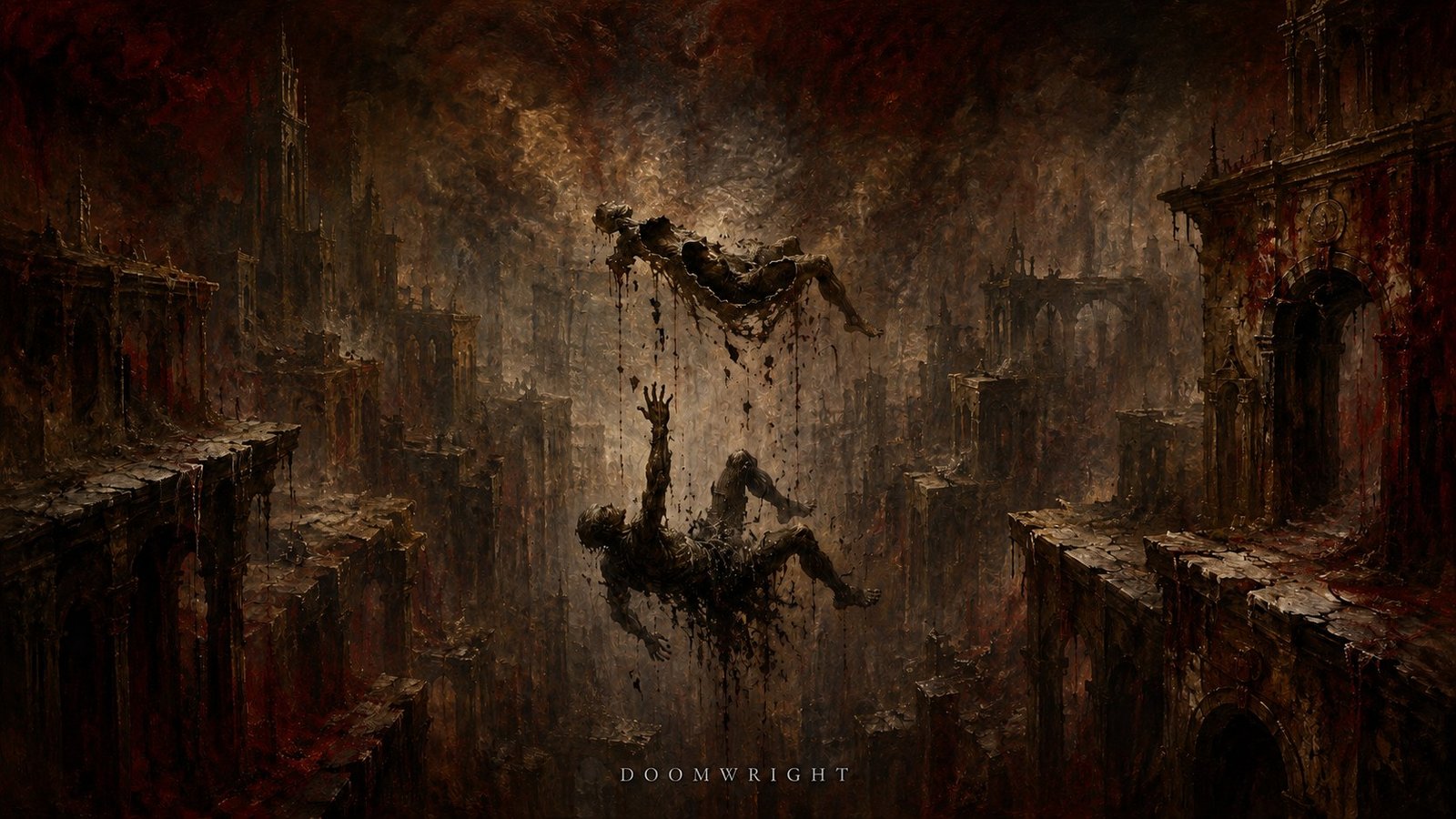
The album begins at the instant of death.
The body falls away.
Identity begins to loosen.
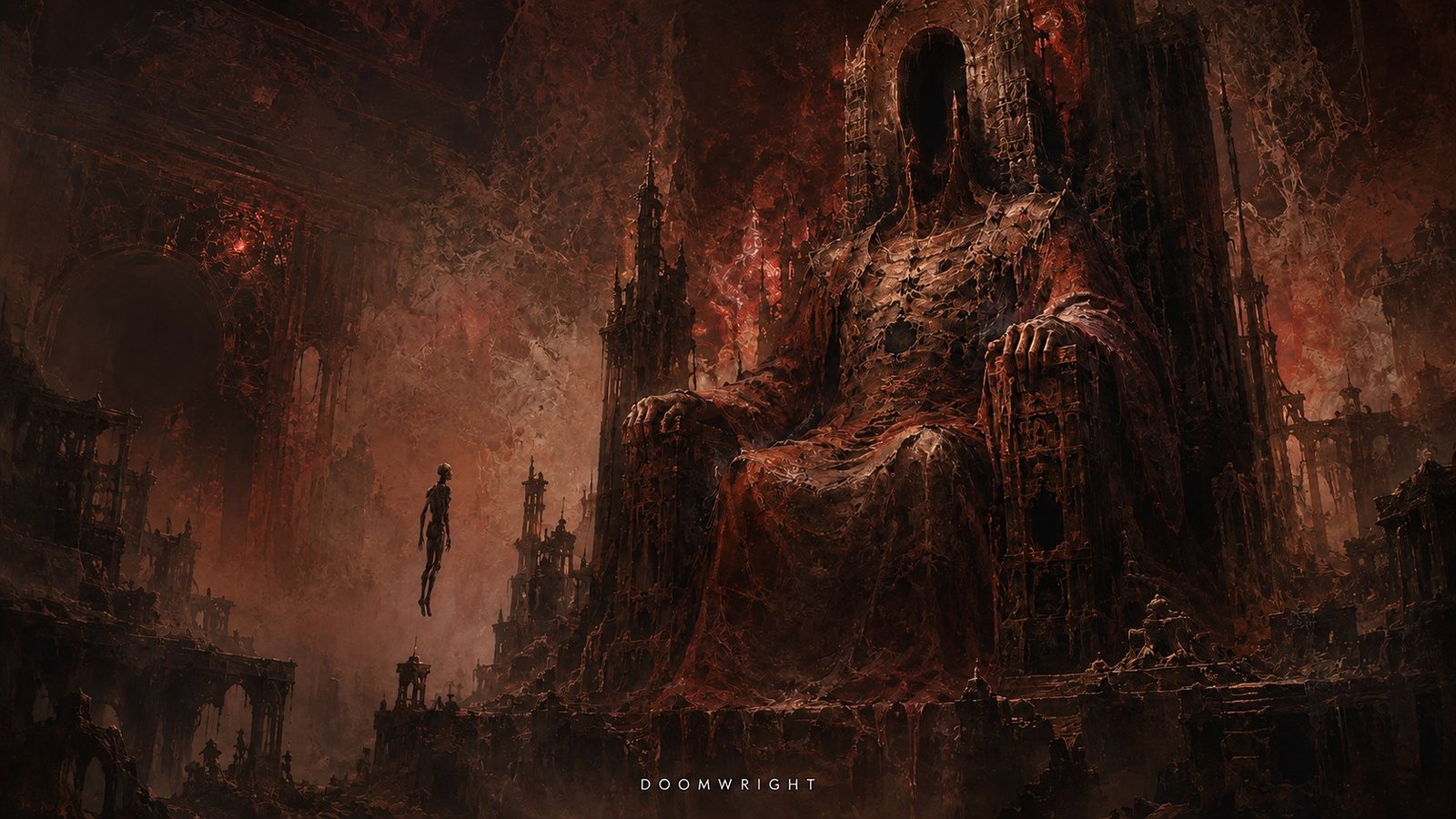
A faceless judge weighs what remains.
Then the soul is sent downward through one punishment after another: black rivers, hooks, fire, cold, mirrors, worms and finally a reckoning at the bottom.
But there is no eternal throne waiting there.
No final monster.
No permanent kingdom of the dead.
At the end, the self is broken apart.
And the wheel turns again.
That became the central idea of THE DESCENDING FIRE:
Hell is not a destination. It is a process.
The record is a ten-track descent through punishment, memory and dissolution, ending not in victory or damnation but in rebirth.
The First Thing to Die Is the Body
Track I is “The Body Falls Away.”
The album does not begin with a funeral.
It begins after the funeral no longer matters.
Breath ends.
Flesh is released.
The familiar world disappears.
And whatever remains begins to fall.
The opening lyric gives the movement immediately:
The thread is severed, breath undone
The flesh released, the falling begun.
There is no stable ground.
No return.
No time to understand what death means before the descent has already started.
That is why I wanted the album to begin fast.
The first movement should not feel contemplative.
Death is not presented as sleep.
It is acceleration.
The body stops.
The journey does not.
Death Removes More Than Flesh
One line in the opening track became especially important:
Torn from the flesh, torn from the name.
The first loss is physical.
The second is identity.
That distinction becomes essential later in the album.
A name is something the living world gives us.
So are titles.
Possessions.
Status.
Reputation.
Once the body is gone, those structures begin losing their authority.
The record therefore does not treat the dead soul as a perfectly intact human personality simply walking through fantastic locations.
Each stage strips something away.
The descent is not only geographical.
It is a reduction.
The Judge Has No Face
Track II is “The Faceless Judge.”
I deliberately did not want a named god, demon or mythological ruler sitting in judgment.
The judge has no personal identity at all.
That makes the scene colder.
The soul cannot bargain through loyalty.
It cannot appeal to a familiar deity.
It cannot flatter the judge.
It cannot even build a personal relationship with the thing deciding its fate.
There is only measurement.
The album describes a ledger.
Scales.
A sentence.
Doors opening downward.
The important idea is not who is judging.
It is that the judgment operates independently of who the dead person believed themselves to be.
That makes the judge less like a character and more like a law.
The Punishment Remembers What the Living Forgot
The first major hell is “River of the Drowned.”
A black river is filled with bodies.
Hands rise from the water.
The dead pull at the newly arrived soul.
The river is not merely scenery.
It introduces one of the album's recurring ideas:
the dead inherit the weight they once ignored.
The song says:
The river takes what the living prize
And carries me down where the last light dies.
The movement is relentless because there is still momentum at this point in the journey.
The soul is being carried.
It has not yet reached the more personal punishments further down.
The Descent Needs a Place Without Words
Track IV is “Embers in the Void.”
It is the only completely instrumental movement on the album.
That was deliberate.
A long descent cannot be made entirely from explanation.
At some point the listener needs to lose the narrator.
No judge.
No confession.
No description of punishment.
Only movement.
The track becomes a passage between realms, carried by harmonized guitar lines rather than language.
It is also where the melodic side of the album is allowed to open most fully.
That contrast matters.
The record is brutal, but brutality without melody would make every hell feel identical.
The instrumental creates distance before the next punishment becomes physical again.
What You Did Returns to You
Track V, “Hooks and Thorns,” is one of the clearest expressions of the album's moral structure.
The punishment is for those who wounded others.
The cruelty returns physically.
The lyric says:
Every wound I gave comes back.
And later:
What I have done is done to me.
That is the principle behind this part of the descent.
Punishment is not random torture.
It is memory made physical.
The dead person is forced to experience what was once external to them.
Pain that belonged to somebody else becomes unavoidable.
The victim's suffering can no longer be treated as distant information.
It becomes environment.
Power Melts in the Furnace
Then comes “The Furnace Mouth.”
This hell belongs to tyrants and those who ruled through cruelty.
Here power becomes useless.
The crown that once signified authority is reduced to molten material.
The song says:
The crown I wore is molten now.
And then:
No throne, no name, no mercy given.
This is where the album turns political power into physical matter.
A crown can control people only while the social world around it agrees that it carries authority.
Inside the furnace it is only metal.
A throne is only an object.
A ruler is only another body.
The punishment removes the abstraction that made power possible.
Fire Is Not the Worst Thing Below
After the furnace, the album changes direction.
Track VII is “Where the Cold Devours.”
This is the counterweight to fire.
The descent has already taught the listener to expect heat.
Then the world becomes white.
Silent.
Frozen.
The lyric deliberately shifts from pain to erasure:
The cold devours the very name.
That distinction matters.
Fire attacks the body.
Cold begins attacking identity.
Memory goes.
Warmth goes.
Even the sense of being a separate self begins weakening.
The album is moving toward something worse than punishment:
dissolution.
The Mirror Is Another Hell
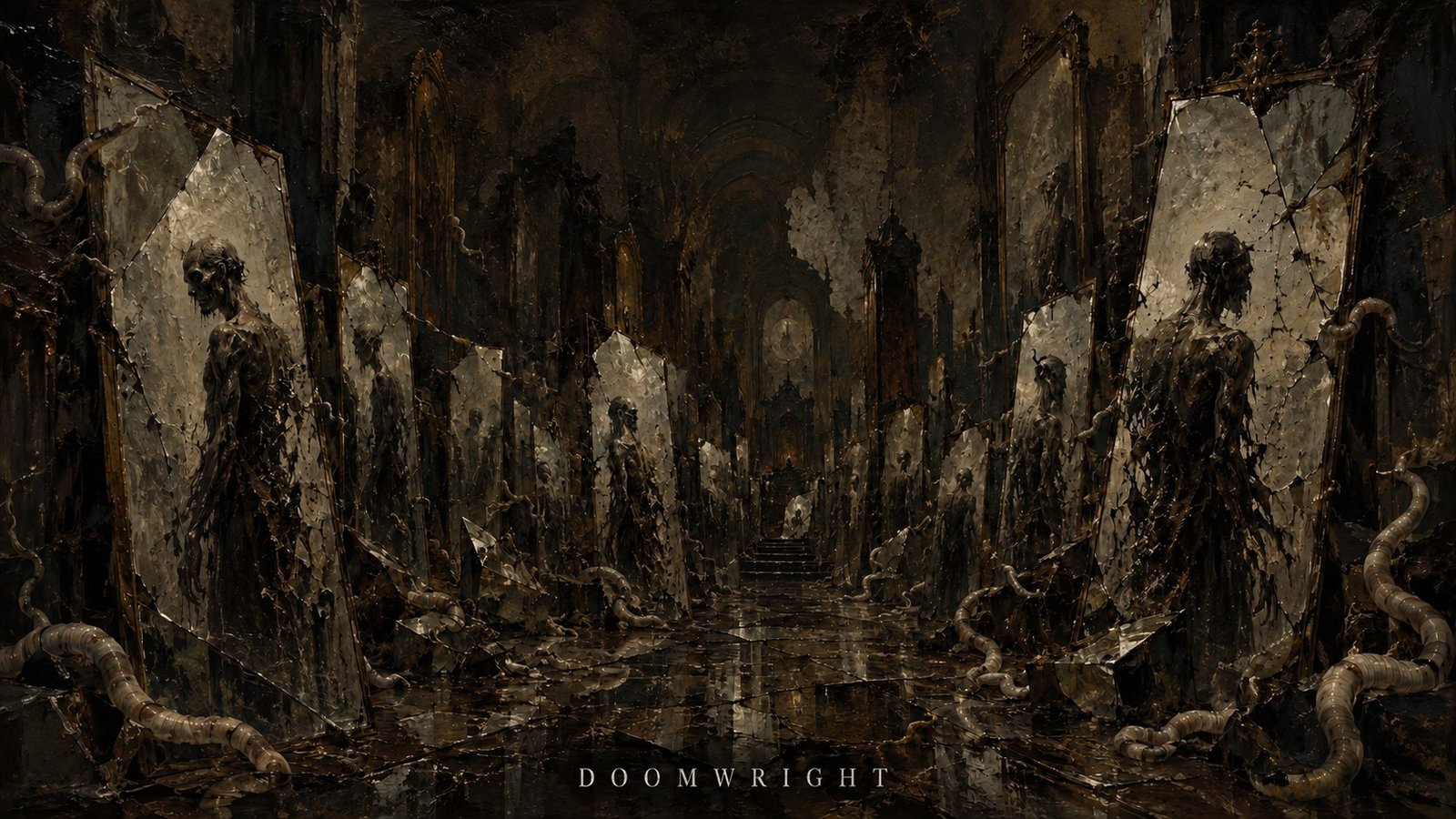
Track VIII is “The Hall of Mirrors and Worms.”
This is the most psychological realm.
The punishment is not simply physical injury.
It is self-confrontation.
Every false identity returns.
Every mask appears.
Every lie has acquired a face.
The lyric says:
The lies I wore now wear my skin.
That is one of the most important lines on the record.
Because a lie is usually something spoken outward.
Here it turns inward.
The false identity begins consuming the person who created it.
The mirrors do not show what the soul wanted others to see.
They show what remained underneath.
Then the worms appear.
The imagery connects deception with decay:
The worm becomes the face I show.
The point is not simply that lying is punished.
It is that false identities eventually become impossible to separate from the person wearing them.
At the Bottom, Only Ash Remains
Track IX is “The Weighing of Ash.”
This is the final reckoning.
The soul has already lost:
the body,
the name,
power,
status,
comfort,
false identity.
What can still be weighed?
Ash.
The track states it directly:
Not gold, not name, not what I owned
Only the ash of what I've grown.
That is the point where the album's descent becomes almost mathematical.
Everything external has been removed.
Possession cannot be weighed.
Rank cannot be weighed.
Self-description cannot be weighed.
Only consequence remains.
And even that is about to disappear.
There Is No Final Hell
A conventional underworld album might end here.
Judgment completed.
Punishment delivered.
The dead remain dead.
But THE DESCENDING FIRE does not stop at judgment.
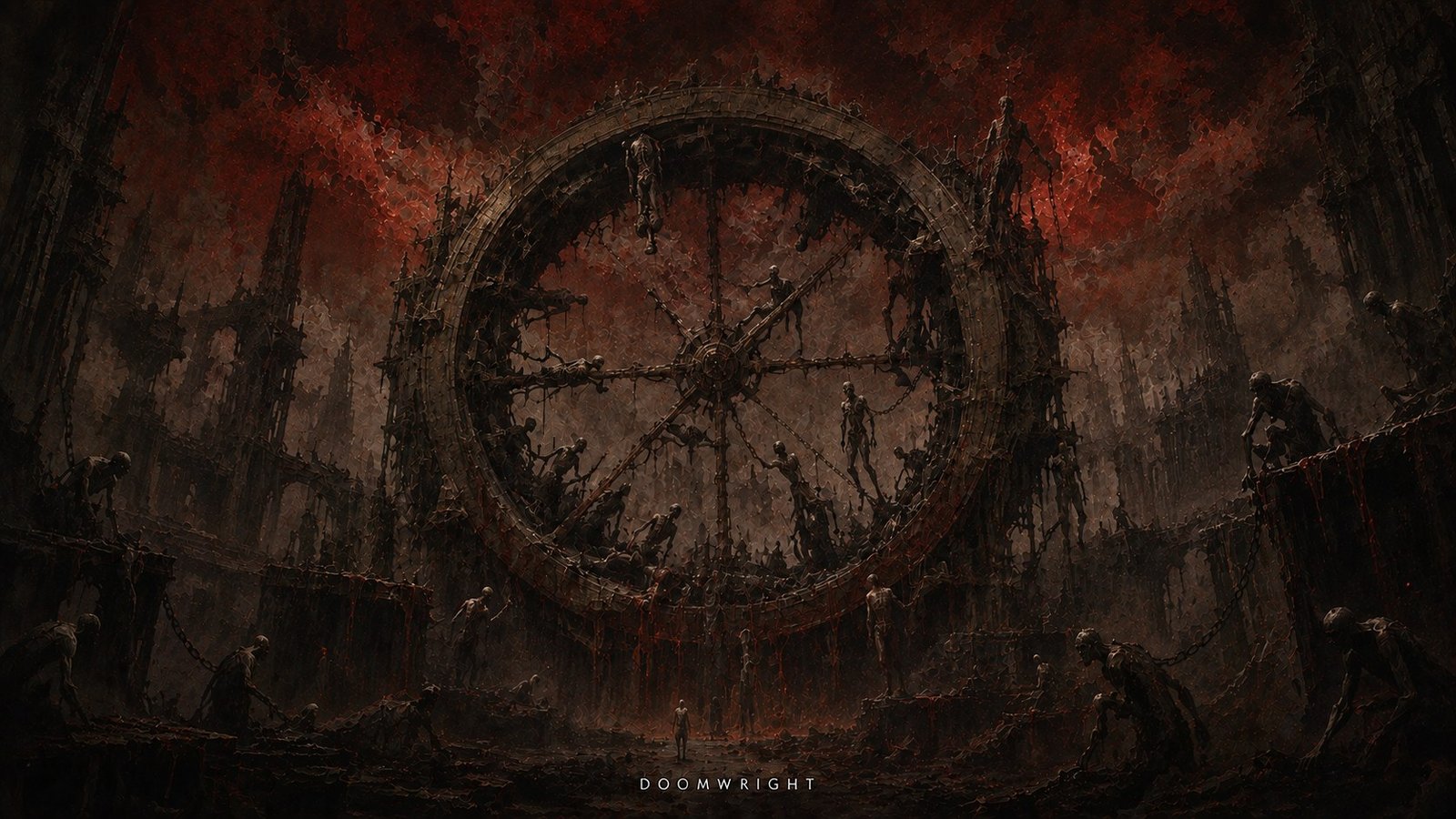
Track X is “Turn of the Wheel.”
The self is unmade.
Identity dissolves.
The journey through Hell does not produce a final resting place.
It produces another beginning.
The lyric says:
No heaven waits, no final rest
Only the wheel, its cold behest.
And then:
Turn the wheel, turn again.
That changes the meaning of everything before it.
The hells were not the final state.
They were part of a cycle.
Death did not end the story.
Judgment did not end the story.
Punishment did not end the story.
Even dissolution does not end the story.
The wheel returns what remains to existence.
Hear the descent.
The Horror Is Forgetting
The final track contains one idea I find more disturbing than eternal punishment.
The soul returns.
But it does not necessarily return carrying a complete memory of what happened.
The cycle can begin again without the person understanding that they have already crossed these realms.
That creates the album's darkest possibility:
Forgetting all, to fall once more
Through every hell I've walked before.
Eternal punishment is terrible because it never ends.
A cycle is terrible for another reason.
It ends—
and then restarts.
There is movement.
Possibility.
Another life.
But also the possibility of repeating the same causes that produced the descent in the first place.
Hell does not need to be eternal if the pattern is.
Why the Album Had to Stay Melodic
Musically, THE DESCENDING FIRE is built around a tension between brutality and melody.
Fast tremolo.
Blast beats.
Deep growls.
High black-metal rasps.
But also harmonized twin-guitar leads and recurring melodic hooks.
The project sheet makes this rule explicit: melody and brutality should reinforce each other rather than compete.
That matters conceptually.
If the record were only violent, the descent would become one long wall of punishment.
The melodic lines carry something else.
Tragedy.
Scale.
The sense that there was once something worth losing.
Even at the most violent moments, the melody reminds the listener that this is still a journey belonging to a soul.
The brutality is the punishment.
The melody is what survives long enough to experience it.
One Soul, Many Hells
That is ultimately what separates THE DESCENDING FIRE from a single-location vision of Hell.
There is no one infernal landscape.
There are many.
River.
Hooks.
Fire.
Ice.
Mirrors.
Worms.
Scales.
Void.
Each stage removes something different.
The album begins with a complete human identity entering death.
By the end, almost nothing recognizable remains.
And then even that nothing is returned to motion.
The full sequence runs:
The Body Falls Away
The Faceless Judge
River of the Drowned
Embers in the Void
Hooks and Thorns
The Furnace Mouth
Where the Cold Devours
The Hall of Mirrors and Worms
The Weighing of Ash
Turn of the Wheel
It is not a journey from life to Hell.
It is:
life → death → judgment → punishment → dissolution → return.
A circle disguised as a descent.
Hear THE DESCENDING FIRE
THE DESCENDING FIRE is a ten-track DOOMWRIGHT brutal melodic black-metal album built around a descent through many hells.
A soul falls from the body.
A faceless judge sends it downward.
The river takes it.
Hooks return every wound.
The furnace melts power.
The cold begins erasing identity.
Mirrors return every lie.
At the bottom, only ash remains.
Then the wheel turns.
The project deliberately uses universal underworld imagery rather than adapting one named religious scripture or mythology, allowing the record to function as its own cosmic descent narrative.
The final horror is not that Hell lasts forever.
It is that Hell can end—
and the journey can begin again.
Turn the wheel… and begin again.
DOOMWRIGHT — THE DESCENDING FIRE