At first, the horror is small enough to understand.
Two travellers find a ruined house.
Inside the remains is a manuscript.
The pages are water-stained.
Someone lived here.
Something happened to him.
And he had just enough time to write it down.
That is how William Hope Hodgson's The House on the Borderland opens its door.
But the story does not remain a story about a ruined house.
It keeps widening.
There is a pit beneath the garden.
Things climb out of it.
The house is attacked.
The man who lives there descends below.
Then time itself begins moving incorrectly.
Years pass.
Centuries.
The sun changes.
The Earth becomes unrecognizable.
Eventually the familiar universe seems almost as fragile as the house itself.
That expansion became the central principle behind the DOOMWRIGHT album THE BORDERLAND:
The house is frightening because it does not stand in one world.
It is a domestic space built over something immeasurably larger.
And every movement of the album pulls another layer away.
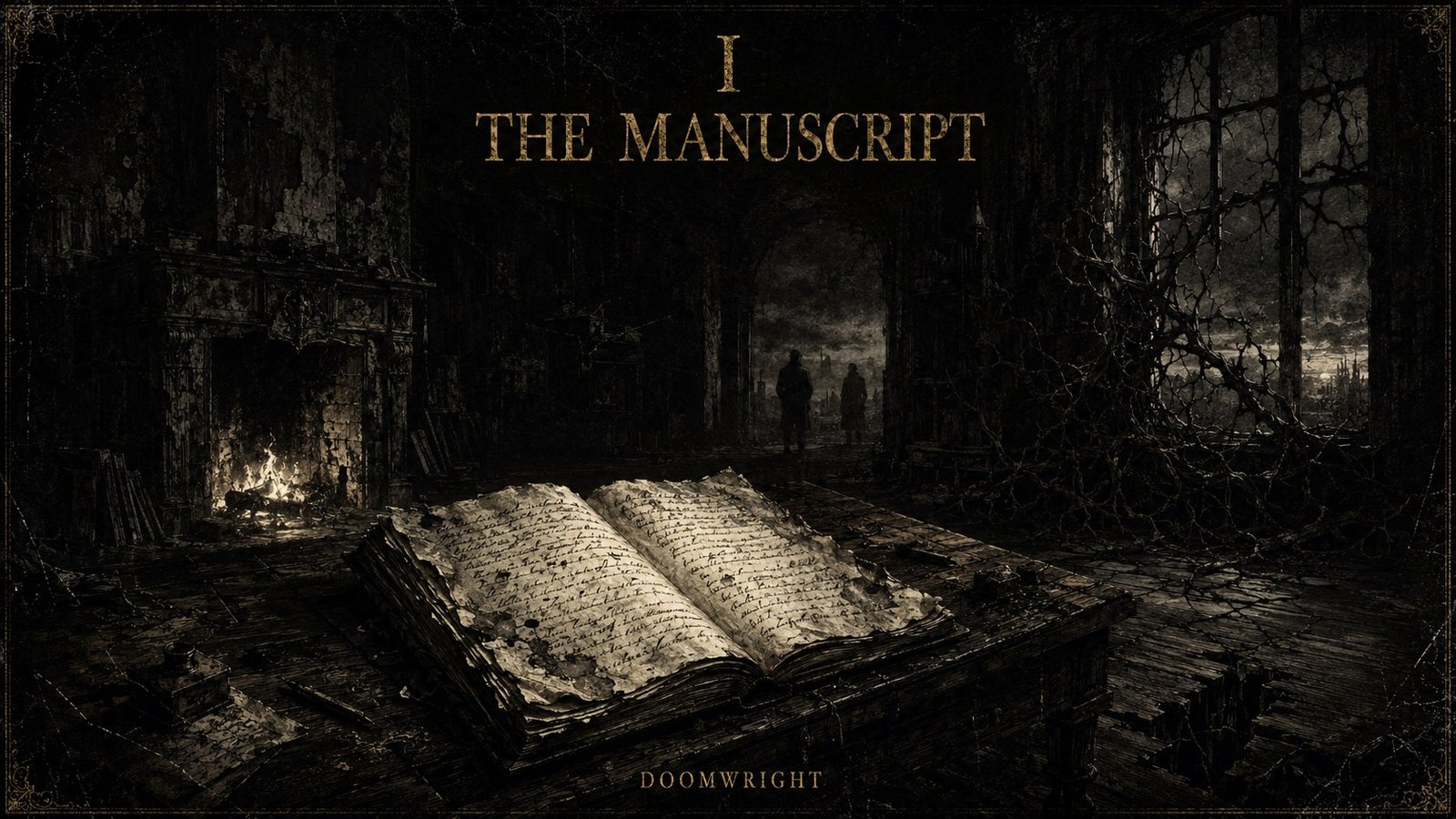
The Manuscript Is the First Door
The album begins with “The Manuscript.”
Not with the Swine-Things.
Not with a monster.
Not even with the Recluse himself.
With a document.
That was important.
Because the reader never encounters the central horror directly.
We encounter somebody else's record of it.
The travellers find ruins, bramble and a damaged book.
They sit down and read.
And from that point forward, the manuscript becomes a doorway.
The opening song describes:
A garden gone to pit and bramble
And under slates a book alone.
Then the warning appears:
There is a rift beneath my garden
And time is not the friend of man.
That line gives away the real scale of the album before the characters understand it.
At first, “rift” sounds geological.
A hole.
A weakness in the ground.
By the end, it means something much larger.
A House With Two Foundations
One of the strongest ideas in Hodgson's novel is that the house gradually stops behaving like ordinary architecture.
A house is supposed to establish safety.
Walls divide inside from outside.
Doors keep unwanted things away.
A cellar has a bottom.
A foundation meets solid earth.
This house cannot provide those guarantees.
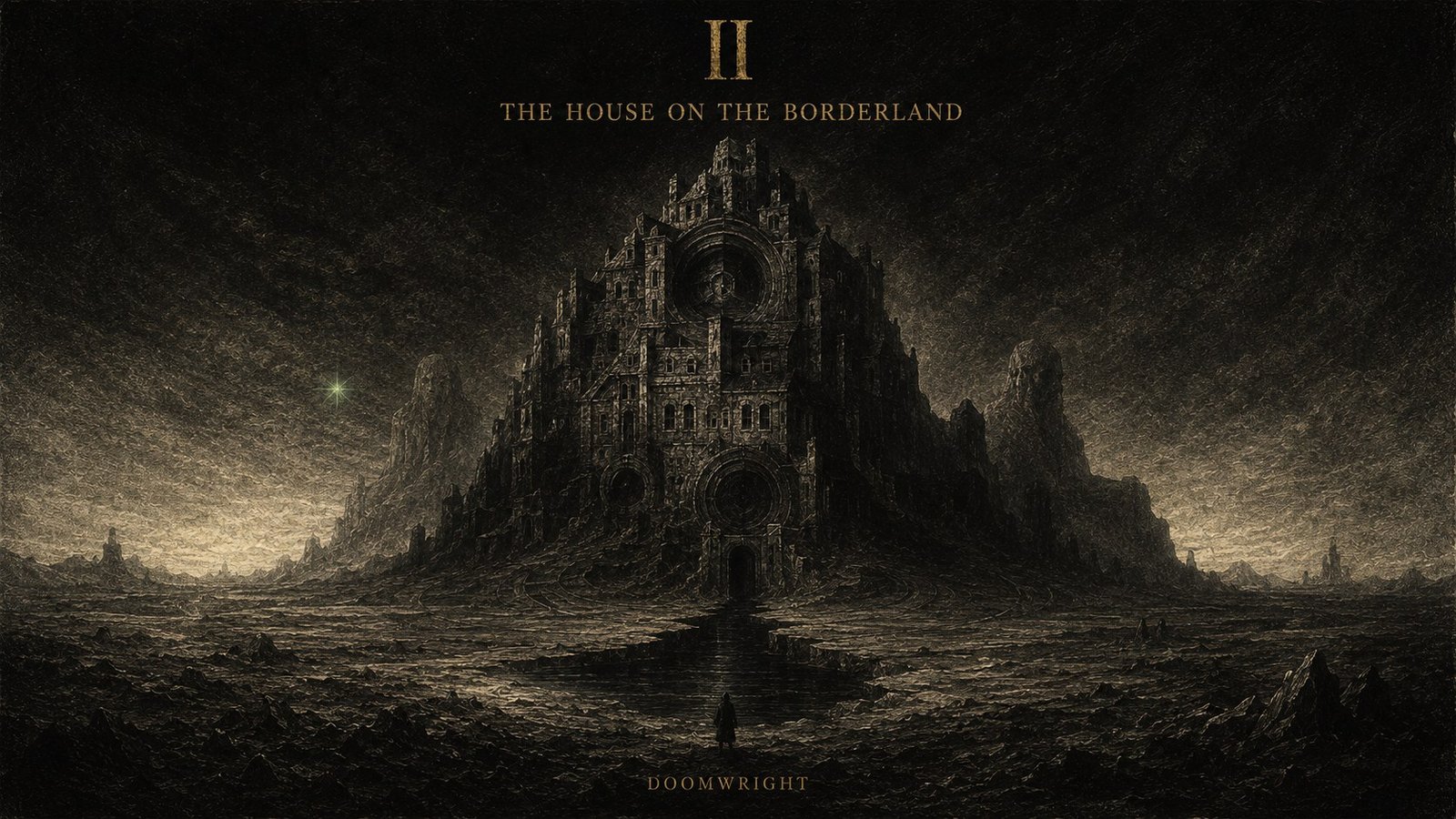
The DOOMWRIGHT title track describes it as:
A house with two foundations
One in Ireland, one in the abyss.
That is the album in two lines.
One foundation belongs to geography.
The other belongs to something that geography cannot explain.
The house stands in Ireland.
But it also appears to exist against another landscape entirely.
That is why I did not want THE BORDERLAND to become simply a haunted-house album.
A haunted house is still a house.
Something supernatural has entered it.
Hodgson's house feels more radical.
The building itself seems positioned where realities meet.
The Pit Is the Throat Beneath the Home
Before the story becomes cosmic, it becomes subterranean.
Track II is “The Pit.”
The Recluse descends with rope and lantern.
The river disappears underground.
The rock does not look merely eroded.
It looks worked.
Something has been shaping the darkness beneath his home.
The track gives the pit another identity:
The pit beneath the garden
The throat beneath the home.
That image matters because a throat is not empty architecture.
A throat connects one place to another.
Something passes through it.
The house above is therefore not simply sitting beside danger.
It is sitting over a passage.
And the Recluse realizes that whatever exists below may have been there far longer than the house itself.
The lyric puts that timescale into stone:
Ten thousand years of patience
Wearing water into stone.
Human architecture suddenly looks temporary.
The pit was waiting before anybody built above it.
Then Something Starts Testing the Walls
The most physically immediate horror arrives with “The Swine-Things.”
White figures appear outside.
Almost human.
Not human enough.
They watch.
They test the doors.
They learn the building.
The frightening detail is patience.
These creatures are not simply charging at the house like animals.
They appear capable of method.
The album describes them:
Snouted, upright, patient
Testing every bar.
The Recluse has a rifle.
His dog Pepper is beside him.
For a moment, the novel almost becomes a siege story.
Inside versus outside.
Gun versus creature.
Door versus pressure.
That kind of horror is comprehensible.
And that is exactly why it cannot last.
Silence Is Worse Than the Attack
The attack gives the Recluse something to do.
Load.
Aim.
Shoot.
Barricade.
Listen.
The Swine-Things are terrifying, but they also give fear a body.
Then they stop.
The song ends with:
And on the fourth night nothing.
Not a sound.
And finally:
Silence is the worst thing they have found.
That is where the album begins preparing for its real transformation.
A monster can be fought.
Silence cannot.
Once the creatures disappear, the Recluse is left with the possibility that the siege was only one expression of something much larger.
The pit remains.
The house remains.
The border remains.
The Swine-Things Are Not the Biggest Horror
This is one of the reasons The House on the Borderland is so strange.
The creatures could have supported an entire conventional horror novel.
Hodgson does not stop there.
The Swine-creatures and the mysterious pit are only part of a story that expands into visions of enormous landscapes and accelerating cosmic time; Project Gutenberg's summary specifically notes both the Swine-creatures and the journey toward the end of the universe.
The monster therefore changes.
First the monster has a body.
Then the monster becomes distance.
Then time.
Then the universe itself.
That progression became the architecture of the DOOMWRIGHT album.
Then Time Breaks
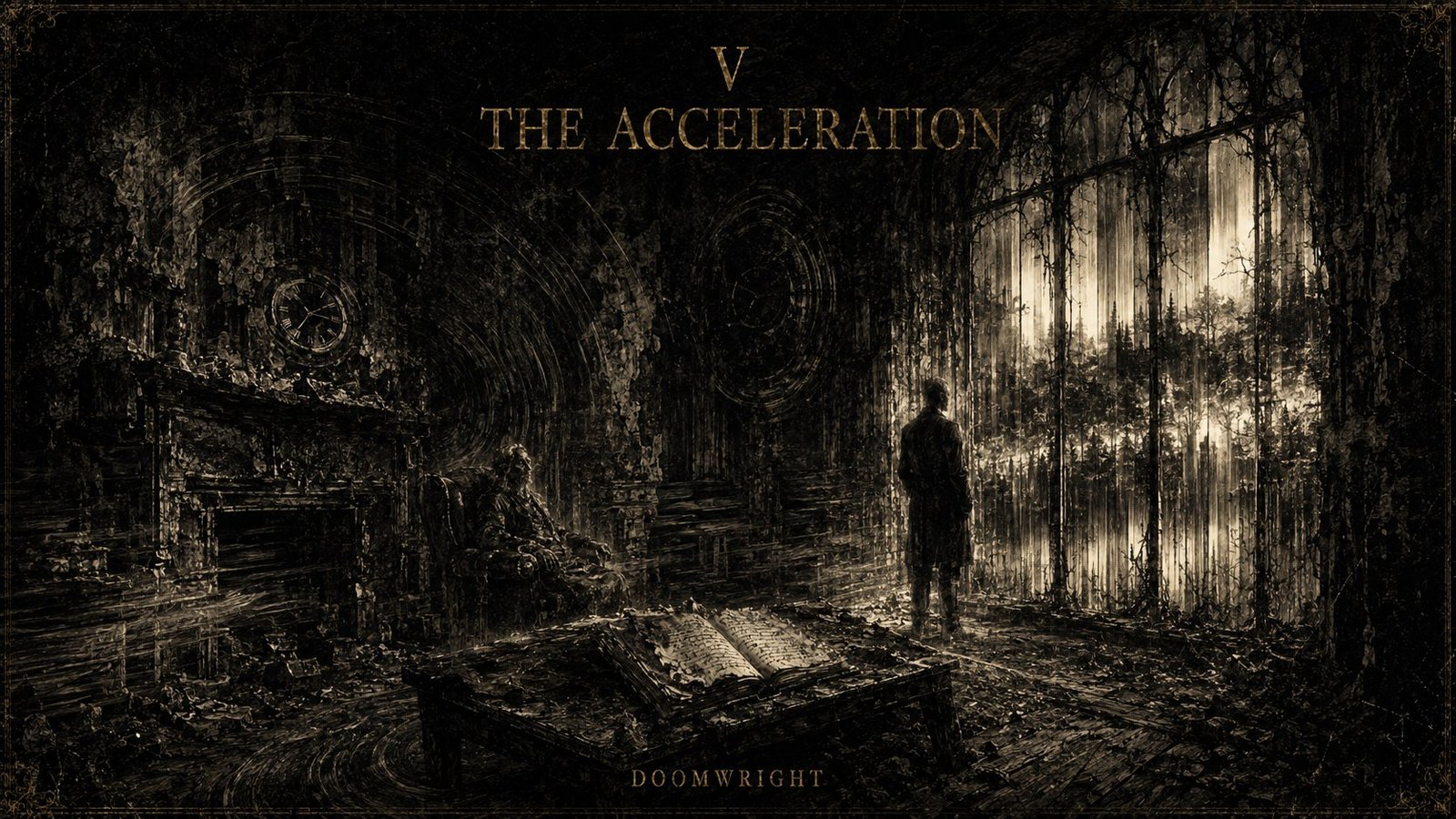
The decisive movement is “The Acceleration.”
Until this point, the Recluse has been dealing with space.
Above.
Below.
Inside.
Outside.
The pit.
The house.
The garden.
Then another dimension becomes unstable.
Time.
A candle appears to burn impossibly fast.
Day and night begin flickering.
Seasons pass.
Years become visible.
The song says:
Dawn dusk dawn, the window flickered
The week went by in flares.
Then:
Years like rain on the window.
That is the moment THE BORDERLAND stops being primarily a creature-horror album and becomes cosmic.
Hear the borderland.
Time Is More Frightening Than the Swine-Things
The Swine-Things threaten the Recluse's body.
Acceleration threatens everything he belongs to.
A human being understands life because time normally moves at roughly the same rate for everyone around us.
We age together.
Buildings age slowly.
Trees grow slowly.
The sun appears stable.
History is something that takes place outside the scale of an afternoon.
Break that relationship and human identity begins collapsing.
The album describes the Recluse as:
The still point of my ruin
Watching the world blur by.
That is the horror of “The Acceleration.”
He does not travel into the future.
The future happens around him.
He watches himself become obsolete.
The House Outlives the Meaning of “Home”
A house is normally associated with continuity.
Generations.
Memory.
Inheritance.
A fixed place to which someone can return.
But if the world outside ages by centuries while the observer remains apart from ordinary time, the word home stops working.
The house becomes something else.
A viewing platform.
A ruin in advance.
A fixed coordinate while the universe moves.
This is why THE BORDERLAND had to keep returning to the building even as the scale became astronomical.
The house is our final human measurement.
Everything beyond it becomes harder to comprehend.
The Sea of Sleep
Then the record does something quieter.
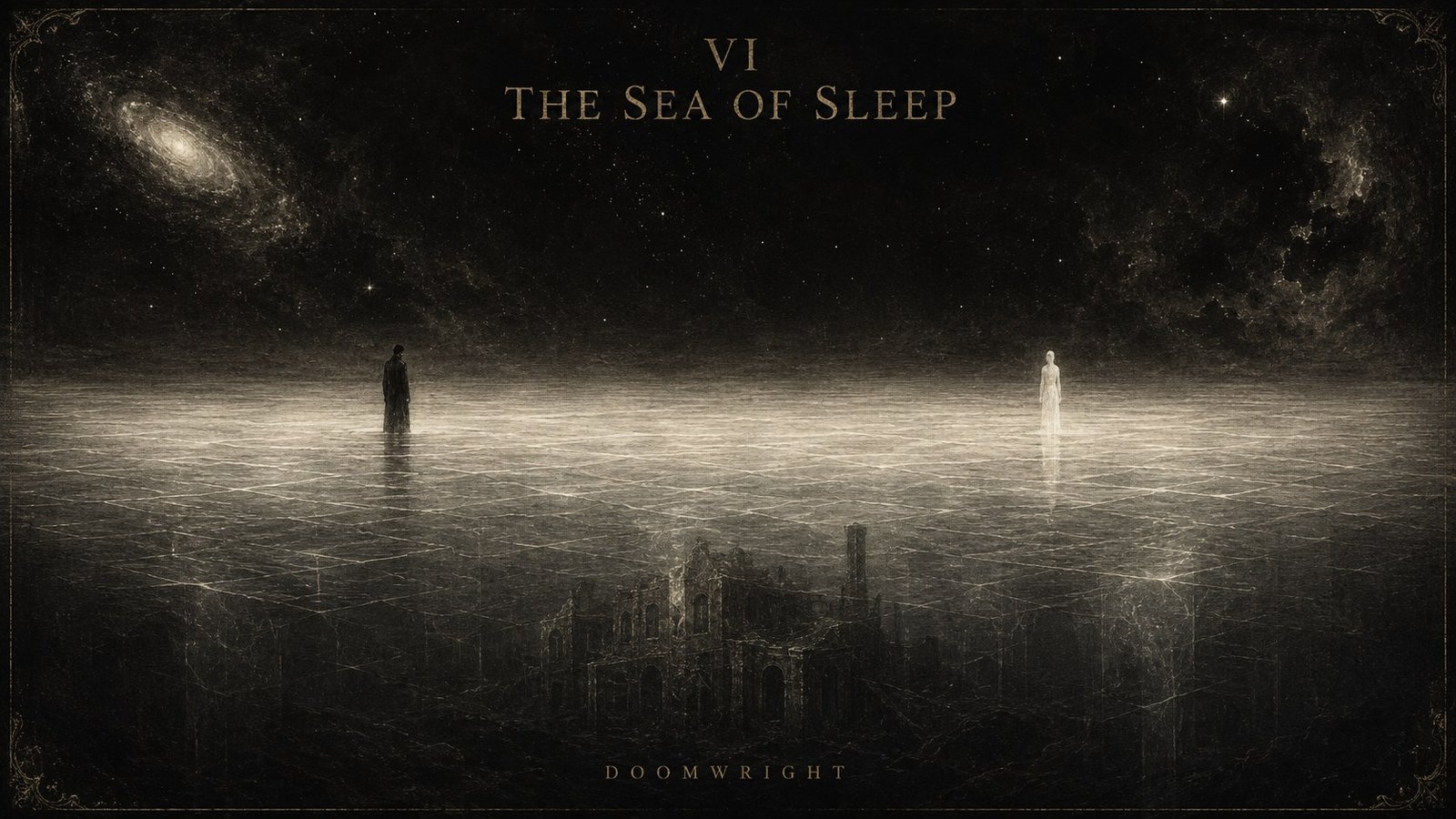
After the violence beneath the house and the terror of accelerated time comes “The Sea of Sleep.”
The rushing stops.
There is water.
Stillness.
And across that impossible place is the woman the Recluse lost.
Suddenly the cosmic horror becomes personal grief.
That was essential.
Because an exploding sun means very little emotionally unless the listener understands what one human being still wants.
He does not want knowledge.
He does not want cosmic power.
He does not want an explanation of the borderland.
He wants someone back.
The song says:
And over it the one the years took
Before this house, before the pit.
And then:
We did not touch.
You cannot touch.
The universe can distort time.
It can show him impossible places.
But it still cannot fully restore the dead.
A Century Can Still Be Too Short
One of the album's simplest lines occurs here:
We stood a century together
It did not feel like much
It felt like all of it.
That is the emotional counterpart to “The Acceleration.”
Earlier, centuries became terrifyingly small.
Now a century becomes emotionally instantaneous.
Objective time has lost authority.
What matters is experience.
That is why “The Sea of Sleep” belongs between acceleration and cosmic destruction.
Without it, the second half of the album would only get bigger.
The Sea makes it human again.
For one movement.
Then the Sun Begins to Die
Track VII is “The Death of the Sun.”
By now the album has moved far beyond the original siege.
The sky itself has become unstable.
The sun changes.
Its familiar light becomes diseased.
The world cools.
The oceans fall silent.
Human history has become irrelevant.
The song begins:
The sun has taken sickness
A green like drowned brass.
Then the star becomes:
A black disc fire-rimmed
A keyhole into nothing.
The scale is almost impossible to reconcile with the opening of the album.
We began with travellers reading a damaged book beside a ruined house.
Now we are watching the death of the system that contained that house.
That distance is intentional.
Pepper Makes the End of the World Hurt
There is one detail in “The Death of the Sun” that matters more than all the cosmic imagery.
Pepper.
The dog.
The record returns to the companion from the siege:
Good dog
Outlasted all the lights.
That is the kind of contrast cosmic horror needs.
The sun dying is enormous.
Almost abstract.
The memory of one dog is comprehensible.
So at the end of astronomical time, the album reaches back toward the smallest relationship in the story.
The universe disappears.
Affection remains meaningful.
The Green Star Is Not Salvation
The final cosmic movement is “The Green Star.”
Beyond the dead familiar system waits something else.
Not rescue.
Not heaven.
Not explanation.
Presence.
The song describes:
The harbor of the burned-out suns
And it is aware of me.
That last idea is worse than emptiness.
An indifferent universe is frightening because humanity does not matter.
A universe containing something that notices you creates another kind of fear.
Suddenly the Recluse is not merely observing the cosmos.
Something may be observing back.
And Then He Wakes in the House
After all of that scale—
dead worlds,
broken time,
the Sea of Sleep,
the dying sun—
the Recluse returns to the study.
The house is still there.
And something is testing the wall.
Quietly.
The cosmic journey has not solved the original problem.
It has made it harder to understand.
The album returns to the language of the pit.
Stone.
Cellar.
Something on the other side.
The narrator begins writing quickly.
Then:
It sounds like more than one.
It sounds like—
The sentence ends.
The Manuscript Stops Before the Horror Does
That may be the most important ending available to a manuscript story.
No final explanation.
No completed testimony.
No authoritative description of what came through.
The writing simply stops.
Then the narrative returns to the travellers who found the document.
The house is ruined.
The author is gone.
The manuscript is all that remains.
The album says:
The writing stops.
Not:
the story ends.
Those are different things.
The event exceeds the document.
Language reaches its boundary before the borderland does.
That Is Why the Album Begins and Ends With Writing
The first movement gives us a manuscript.
The final movement destroys its ability to continue.
Between those two points, the scale expands almost absurdly:
page → house → pit → creatures → other world → accelerated time → cosmic extinction → unknown presence → page
That circle is what made the project work for me.
The manuscript is tiny compared with the things it contains.
A handful of pages holds the death of the sun.
That disproportion is cosmic horror in miniature.
The House Is the Anchor
The album could easily have become a sequence of unrelated cosmic visions.
The house prevents that.
No matter how far the Recluse travels, the listener remembers:
the cellar,
the garden,
the walls,
the dog,
the pit.
That physical continuity gives the impossible images weight.
The DOOMWRIGHT title track states the concept directly:
The Borderland
A house with two foundations
One in Ireland, one in the abyss.
The building is both home and threshold.
Architecture and wound.
Shelter and entrance.
It does not merely contain the supernatural.
It is structurally connected to it.
Why THE BORDERLAND Had to Change Scale Musically
That also determines the musical architecture.
The first part of THE BORDERLAND can still behave like physical horror.
Weight.
Siege.
Riffs with identifiable threat.
The pit below.
Creatures at the doors.
But once “The Acceleration” begins, the record needs more space.
Repetition.
Atmosphere.
Longer perception.
The sense that the human observer is becoming tiny inside events that no longer fit human time.
That is why I think of the record as cosmic atmospheric black metal, rather than simply black metal attached to a horror novel.
Atmosphere is not decoration here.
It represents scale.
Horror That Keeps Moving Away From You
The genius of the story's structure is that every time the reader begins to understand the threat, the threat becomes larger.
Swine-Things?
Barricade the door.
A pit?
Explore it.
Another world?
Try to understand it.
Time accelerating?
There is nothing to fight.
The sun dying?
There is nowhere to go.
Something beyond the dead stars watching?
There may not even be language adequate to describe it.
That escalation strips away human responses one after another.
The rifle works against a creature.
It does nothing against time.
From Cellar Door to Dead Sun
That is the journey I wanted THE BORDERLAND to preserve.
Not merely the events of Hodgson's story.
The changing scale of fear.
The album's eight movements follow that widening:
The Manuscript — the document is discovered.
The Pit — the house opens downward.
The House on the Borderland — the building reveals its second existence.
The Swine-Things — the threat becomes physical.
The Acceleration — time breaks.
The Sea of Sleep — cosmic scale becomes personal grief.
The Death of the Sun — human history disappears.
The Green Star — something remains beyond the familiar universe.
And then the manuscript ends.
The story has travelled from a book under fallen slates to the death of a star—
without ever fully leaving the house.
Hear THE BORDERLAND
THE BORDERLAND is an eight-movement DOOMWRIGHT cosmic atmospheric black-metal album after William Hope Hodgson's The House on the Borderland.
Two travellers discover a manuscript in the ruins of a lonely Irish house.
Inside it, a Recluse describes a pit beneath his garden, creatures testing his doors, another landscape touching his home, the violent acceleration of time, the Sea of Sleep, the death of the sun and something waiting beyond the familiar stars.
Then the manuscript stops.
The album's central movement is therefore not simply from safety into horror.
It is from human scale into cosmic scale.
The house remains the fixed point while everything around it becomes impossible.
A house with two foundations.
One in Ireland. One in the abyss.
DOOMWRIGHT — THE BORDERLAND